Fenny Skalter
Price: $14.95
Fenny Skaller
John Henry Mackay
Fenny Skaller, a novel, traces the growth of a love and self-knowledge through a series of flashbacks, as Skaller, a man in his forties, reflects on his passing affairs and lasting relationships with youths. Each chapter is a photograph…
Praise for the Author…
“John Henry Mackay belonged to those who first meant for me the intellectual life, the modern. In him are united for me the concept of social-philosophical daring, and a love from which many a melodious song sprang, and which may also be the source of his daring.” — Thomas Mann
“One of the most distinguished and genuine figures in German literaure since the 1880’s.”— Hermann Hesse
“Mackay broke truly new ground as a writer through his commitment to the homosexual liberation movement. His most important works are Fenny Skaller and The Hustler.” — Edward MorninAbout the Author
Read more about: Fenny Skalter »
“The Scottish-German John Henry Mackay,...The Struggle for Ecological Agriculture in Cuba
Price: $3.00
The Struggle for Ecological Agriculture in Cuba
... Read more about: The Struggle for Ecological Agriculture in Cuba »
Richard LevinsKarl Marx: An Illustrated Biography
Price: Original price was: $25.00.$12.95Current price is: $12.95.
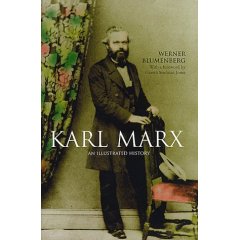
Karl Marx: An Illustrated Biography
Read more about: Karl Marx: An Illustrated Biography »
Werner Blumenberg
Reissued in the year of the 150th anniversary of The Communist Manifesto, this classic biography of Karl Marx is unlike any other account of its subject.
Focusing as much on Marx’s private life as on his public persona and work, it looks in detail at his relationships with his mother and father, wife and friends, and includes generous quotations from a wide range of correspondence. Blumenberg examines Marx’s early writing as a schoolboy and his romantic poetry whilst a student, as well as his exchanges with close friend and collaborator Frederick Engels. In these pages are moving accounts of the privations of Marx’s poverty-stricken life in London and the tragedies which struck his family, as well as discussions of his intellectual development and political activity.
The book includes virtually every photograph in existence of Marx and his closest associates. A friend wrote of Marx when he was just twenty-four years old: ‘Imagine Rousseau,...Participatory Autonomy
Price: $14.95
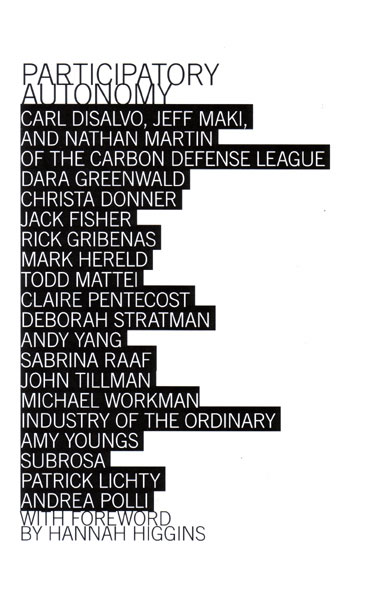
Participatory Autonomy
Rick Gribenas, ed.Table of Contents
Foreword: Sociocybernetics in Autonomy
Hannah HigginsPreface: A Call to Participate
Rick GribenasAutonomy, Participation, and
Claire PentecostFinding the right place for this moment: Maphub and our pursuit of an engaged presence.
Carl DiSalvo, Nathan Martin, Jeff MakiObjects for Failed or Failing Systems
Deborah StratmanCode Like Paint
Mark HereldGhost in the Machine
Jack FisherYour New Organ(ism)
Christa Donner
Thesis: Antythesis (Considering participation among the tiny)
Andy YangThe SamaraS Project
Dara GreenwaldPropagation
Sabrina RaafNotes on Contributors
The Margin Suites — CD
... Read more about: Participatory Autonomy »
Todd Mattei and Rick GribenasAfter the New Economy
Price: Original price was: $24.95.$9.95Current price is: $9.95.
After the New Economy
Doug Henwood”Fast, funny, and consistently merciless toward the purveyors of economic delusion and deception. I feel ten times smarter than I was before I read this book!” – Barbara EhrenreichRarely a day went by in the dizzy 1990s without some well-paid pundit heralding the triumphant arrival of a “New Economy.” According to these financial mavens, an unprecedented technological and organizational revolution had extinguished the threat of recession forever. Though much of the rhetoric sounds ridiculous today, few analysts have explored how the New Economy moment emerged from deep within America’s economic and ideological machinery—instead, they’ve preferred to treat it as an episode of mass delusion.
Now, with customary irreverence and acuity, journalist Doug Henwood dissects the New Economy, arguing that the delirious optimism was actually a manic set of variations on ancient themes, all promoted from the highest of places. Claims of New Eras have plenty of historical precedents; in this latest act,...
Read more about: After the New Economy »The Epitaph Project
Price: $9.95
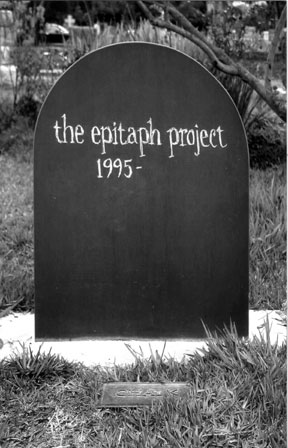
The Epitaph Project
1995–
Joyce Burstein
Introduction by Peter Lamborn Wilson
Joyce Burstein began the epitaph project in 1995 by securing a mortgage for a plot at Hollywood Forever, an historic cemetery in Los Angeles known for housing the remains of Rudolph Valentino and other silent film era stars.The public artwork exists as a tombstone carved from slate like a chalkboard and is accompanied by a bronze box containing chalk. Passersby are invited to write an epitaph on the stone. Burstein collects these sometimes profound or irreverent compositions with a photograph.
The project has expanded to include two multi-media presentations, a website, an installation, and the present book, of more than 300 selections, featuring an essay by Peter Lamborn Wilson.
This ongoing project enlists the help of all spectators in a process of self-discovery about death and life, as one does not exist without the other.
... Read more about: The Epitaph Project »