Political Essays
Price: $14.95
Political Essays
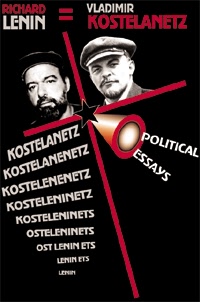
Richard Kostelanetz“Only thinking that transcends the old pieties and categories — that is clearly beyond both ‘left’ and ‘right’ — can discover the new sources of malaise and formulate ideas that will nourish the roots of our future common experience,” wrote Richard Kostelanetz way back in 1968, in ‘Radical Thought for Our Times,’ one of the prescient contributions to Political Essays, a collection culled from four decades of his critical writing.
Drawing insight from his life as an incorrigibly independent writer — together with the influences of John Cage, Dwight Macdonald, and R. Buckminster Fuller, et al., — Kostelanetz penetrates social and political issues with writing that is persuasive and at times funny. Courageous in his choice of subjects, here he examines: P.C. propaganda in ‘Me and AIDS Journalism,’ racism in ‘The Harlem I Knew,’ and the intellectual limits of the daily news in ‘The Perils of Newspaper Literacy.’ Anarchist and libertarian,...
Read more about: Political Essays »Gulliver
Price: $8.95
Gulliver
... Read more about: Gulliver »
A Novel
Michael Ryan
An allegorical history of the present. Gulliver embarks upon a strange space-age journey of uncanny cultural resemblances and disturbing personalencounters. A political satire that brings us face-to-face with the imperial cannibalism of white capitalist patriarchy and the food chain that constitutes itsmajor social institutions. Ryan parodies virtually every political utopian vision that has ever been advanced.Film & Politics in the Third World
Price: $14.95
Critical articles — most of them written by Third World writers — on leading figures and national & regional cinemas. Includes analyses of important individual films, political/aesthetic manifestoes, and interviews with African, Chinese, Indian, Turkish, Iranian, Arab, Filipino, Cuban, and Latin American directors.
... Read more about: Film & Politics in the Third World »Format & Anxiety
Price: $14.95
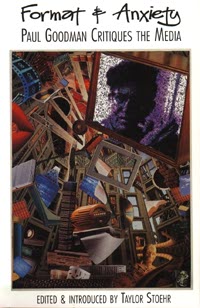
Format and Anxiety
... Read more about: Format & Anxiety »
Paul Goodman Critiques the Media
Edited by Taylor Stoehr
Paul Goodman challenges us to respond to the dominant media representations that pare away complex truths to createthe bold, simplified images that controlling systems require to maintain and justify their existences. On a worldwide scale, the media has homogenized almost all regional and local diversity. Where remnants of original cultures exist, they are being marginalized, packaged as artifacts, and marketed as nostalgia.Blue Tide
Price: $14.95
Blue Tide
The Search for Soma
Mike JayIn the beginning, there was soma. The Rig Veda, the earliest sacred text of the ancient Indo-Europeans, includes dozens of hymns in praise of this psychedelic plant which, when drunk, takes its subjects to the realm of the gods on its “blue tide.” But, in the later Hindu tradition, soma is declared to have been “lost,” and its use abandoned. The botanical identity of soma remains one of the great unsolved mysteries of the ancient world.
Read more about: Blue Tide »
Blue Tide tells the story of the search for soma, and uses a diverse range of approaches — travel and ethnography, science and narrative history, detective story and first-person drug experiences — to examine the question of its nature and identity. The search takes the author from drug rituals in Brazilian churches to the high Indus Valley in the Himalayas. In doing so, it sheds light not just on the identity of soma but on the broader mystery of the original relationship between psychedelic drugs and religion....Economising Culture
Price: $15.00
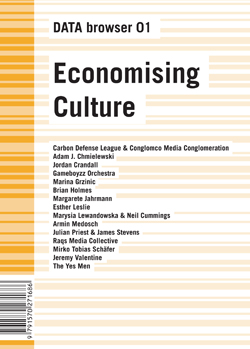
Economising Culture
Data Browser 01
On the (Digital) Culture Industry
Geoff Cox, Joasia Krysa & Anya LewinThe interaction between culture and economy was famously explored by Theodor Adorno and Max Horkheimer by the term ‘Kulturindustrie’ (The Culture Industry) to describe the production of mass culture and power relations between capitalist producers and mass consumers. Their account is a bleak one, but one that appears to hold continuing relevance, despite being written in 1944. Today, the pervasiveness of network technologies has contributed to the further erosion of the rigid boundaries between high art, mass culture and the economy, resulting in new kinds of cultural production charged with contradictions. On the one hand, the culture industry appears to allow for resistant strategies using digital technologies, but on the other it operates in the service of capital in ever more complex ways. This publication, the fi rst in the DATA browser series, uses the concept of the culture industry as a point of departure,...
Read more about: Economising Culture »