Anarcho-Syndicalism
Price: $12.95
Anarcho-Syndicalism: Theory and Practice
Rudolf Rocker
Preface by Noam Chomsky“The publication of Rudolf Rocker’s Anarcho-Syndicalism is an event of much importance for people who are concerned with problems of liberty and justice. Rocker expresses throughout his faith in the capacity of ordinary people to construct for themselves a world suited to their inner needs, to create and participate in an advancing culture of liberation in free communities, to discover through their own thought and engagement the institutional arrangements that can best satisfy their deeply rooted striving for freedom, justice, compassion and solidarity, at a particular historical moment. This vision remains as inspiring as when it was written a half century ago, and no less valid as a stimulus to our thinking and our constructive action.” —Noam Chomsky
Read more about: Anarcho-Syndicalism »
“[Rocker’s] exposition of anarcho-syndicalism at the peak of its influence is both a precious document of its time and a valuable reminder in our time of the continuing importance of an essential element in the complex ideology of anarchism.”...Dreams of Freedom
Price: $19.95
Dreams of Freedom
A Ricardo Flores Magón Reader
Edited by Chaz Bufe and Mitchell Cowen VerterThe most comprehensive anthology of the Mexican revolutionary’s writings available in English. Translated, compiled, and annotated by Mitchell Verter and Chaz Bufe. Also includes a lengthy biographical preface by Verter.
Read more about: Dreams of Freedom »
The words of this Mexican-American working class hero brought to English language readers for the first time.
“From the darker nations comes the vibrant and still fresh voice of the tremendous anarcho-communist Flores Ricardo Magon. In Mexico they have streets named after him. Elsewhere he is little known. Hopefully those who are illiterate in Spanish will now take this great radical into our hearts through this very powerful collection. Land and Liberty!” —Vijay Prashad
Along with Emiliano Zapata, Ricardo Flores Magón (b. 1874) is regarded as one of the most important figures of the Mexican Revolution. Through his newspaper Regeneración, he boldly criticized the injustices of the country’s military dictatorship and worked to build the popular movement that eventually overthrew it....Expect Resistance
Price: $10.00
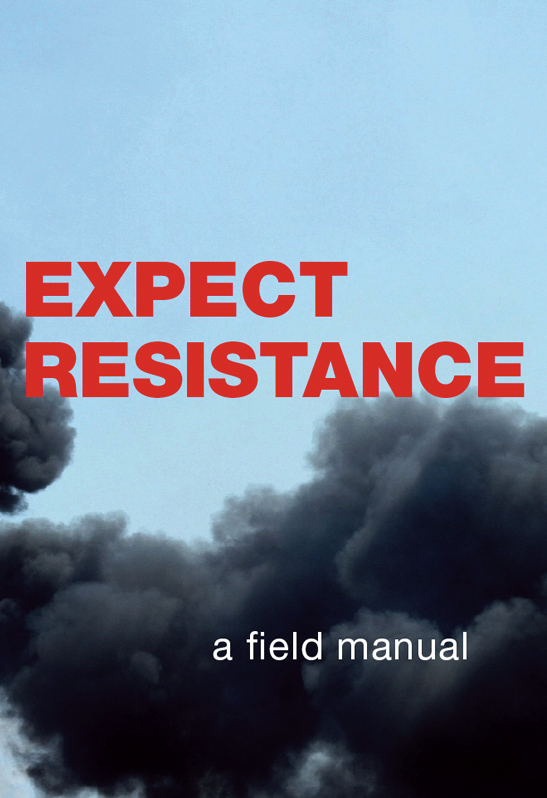
Expect Resistance
A Field Manual
Crimethinc Ex-Worker’s CollectiveExpect Resistance is not one but three books, each of which may be read as a complete work unto itself. The first book, printed in standard black ink, continues the inquiry into modern life and its discontents begun in Days of War, Nights of Love. Just as that book included improved versions of texts originally published between 1996 and 1999, this book draws on CrimethInc. material from 2000 to 2004, painstakingly refined and augmented with a great deal of new content. The second book, in red ink, is a composite account, related by three narrators, of the adventures and tribulations that inevitably ensue when people pursuing their dreams enter into conflict with the world as it is.
Together these comprise a third book, an exploration of the complex relationship between ideals and reality. Expect Resistance is a field manual for a field on which all manuals are useless,...
Read more about: Expect Resistance »Constituent Imagination
Price: $21.95
Constituent Imagination
Militant Investigations, Collective Theorization
Erika Biddle, Stevphen Shukaitis, and David Graeber (Editors)From the ivory tower to the barricades! Radical intellectuals explore the relationship between research and resistance.
What is the relationship of radical theory to movements for social change? In a world where more and more global struggles are refusing vanguard parties and authoritarian practices, does the idea of the detached intellectual, observing events from on high, make sense anymore? In this powerful and unabashedly militant collection, over two dozen academic authors and engaged intellectuals—including Antonio Negri and Colectivo Situaciones—provide some challenging answers. In the process, they redefine the nature of intellectual practice itself.
The twenty essays cover a broad range: embedded intellectuals in increasingly corporatized universities, research projects in which factory workers and academics work side by side, revolutionary ethnographies of the Global Justice Movement, meditations on technology from the branches of a Scottish tree-sit. What links them all is a collective and expansive re-imagining of engaged intellectual work in the service of social change....
Read more about: Constituent Imagination »The Russian Anarchists
Price: $19.95
The Russian Anarchists
Paul Avrich
In the turmoil of the Russian insurrection of 1905 and civil war of 1917, the anarchists attempted to carry out their program of “direct action”—workers’ control of production, the creation of free rural and urban communes, and partisan warfare against the enemies of a free society.Avrich consulted published material in five languages and anarchist archives worldwide to present a picture of the philosophers, bomb throwers, peasants and soldiers who fought and died for the freedom of “Mother Russia.” Including the influence and ideas of Bakunin and Kropotkin, the armed uprisings of Makhno, the activities of Volin, Maximoff, and the attempted aid of Berkman and Emma Goldman.
“It combines exact scholarship with imaginative insight, intellectual grasp and readability. The author has a flair for concrete instance that makes the milieu which he describes alive and he conveys not only what people said and did but also what they meant and felt.”—Times Literary Supplement
The late Paul Avrich was professor of history at Queens College,...
Read more about: The Russian Anarchists »Anarchy After Leftism
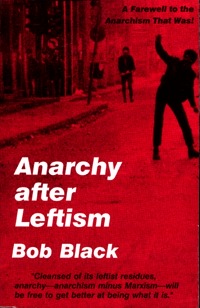
Price: $7.95
A reply to, and an assault on, Murray Bookchin’s ‘Social Anarchism Or Lifestyle Anarchism,’ Bookchin himself, Bookchinism, and so called ‘anarcho-leftism.’
Read more about: Anarchy After Leftism »
“Black does not write particularly well if judged solely on the grounds of grammar, yet one area where he is at his strongest is in vociferous humourous criticism” – Do or Die
...