Fearless Speech
Price: $11.95
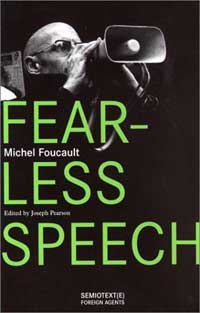
Comprised of six lectures delivered, in English, by Michel Foucault while teaching at Berkeley in the Fall of 1983, Fearless Speech was edited by Joseph Pearson and published in 2001. Reviewed by the author, it is the last book Foucault wrote before his death in 1984 and can be read as his last testament. Here, he positions the philosopher as the only person able to confront power with the truth, a stance that boldly sums up Foucault’s project as a philosopher.
Still unpublished in France, Fearless Speech concludes the genealogy of truth that Foucault pursued throughout his life, starting with his investigations in Madness and Civilization, into the question of power and its technology. The expression “fearless speech” is a rough translation of the Greek parrhesia, which designates those who take a risk to tell the truth; the citizen who has the moral qualities required to speak the truth, even if it differs from what the majority of people believe and faces danger for speaking it....
Read more about: Fearless Speech »Foucault Live
Price: $19.00
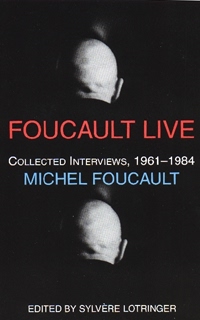
This is the only major collection of Michel Foucault’s interviews. Foucault dreams “of an intellectual destroyer of evidence and universalities who incessantly displaces himself, [and] doesn’t know exactly where he is heading [or] what he’ll think tomorrow because he is too attentive to the present.” Composed of every extant interview made by Foucault from the mid-60s until his death in 1984, Foucault Live sheds new light on the philosopher’s ideas about friendship, the intent behind his classical studies, while clarifying many of the professional and popular misinterpretations of his ideas over the course of his career. Most notably, Foucault Live includes interviews he made with the gay underground press during his stays in America during the 1970s. In them, Foucault suggests that homosexuality presents a new paradigm for ways of living beyond the predictable, binary couple. All of the philosopher’s interests, from madness and delinquency to film and sexuality, and their resultant writings, are probed by knowledgeable critics and journalists....
Read more about: Foucault Live »Why Different?
Price: $12.95
“Abolishing the rights and privileges of one genderover another means working for the possibility of a world democratic culture. But this can only happen in the respect of differences, in order to avoid this culture being abstract and not real.” For Luce Irigaray, one of the most original French feminist theorists, deconstructing the patriarchal tradition is not enough. She admits that it is not an easy task, but she believes that it is necessary to also define new values directly or indirectly suitable to feminine subjectivity and to feminine identity. She begins this project by analyzing and interpreting the absence of the feminine subject in the definition of dominant cultural values. She then wonders how these new values can be constructed without simply reversing the roles. Far from implying a hierarchy, difference affirms the coexistence and fruitful encounter of two different identities. These two heterogeneous identities, masculine and feminine, are not socially but ontologically constructed and describing the feminine requires establishing methods other than those already used by the masculine subject....
Read more about: Why Different? »Chaosophy
Price: $12.95
“When I was a child, I was, so to speak, in pieces: really a little schizo around the edges. I spent years trying to put myself back together again. Only my thing was, I would pull along different pieces of realities in doing it.” This collection of essays and interviews edited by Sylvère Lotringer and published in 1995, focuses on the French anti-psychiatrist and theorist’s work as director of the experimental La Borde clinic (“A Clinic Unlike Any Other”) and longtime collaborator with the philosopher Gilles Deleuze.
Chaosophy/iis a groundbreaking introduction to Guattari’s theories on “schizo-analysis”: a process meant to replace Freudian interpretation with a more pragmatic, experimental, and collective approach rooted in reality. Unlike Freud, Guattari believes that schizophrenia is an extreme mental state induced by the capitalist system itself, which keeps enforcing neurosis as a way of maintaining normality. Guattari’s post-Marxist vision of capitalism provides a new definition not only of mental illness, but also of the micropolitical means of its subversion....
Read more about: Chaosophy »Pure War
Price: $12.95
“We tried to reveal a number of important tendencies: the question of speed; speed as the essence of war; technology as the producer of speed; war as logistics, not strategy; endocolonization; deterrence; ultimate weapons; Pure War.”
The publication of Pure War in 1983 introduced Virilio’s thought to the United States, and has since remained one of the most influential and far-reaching essays of our time. Pure War names the invisible war that technology is waging against humanity. For Virilio, the foremost philosopher of speed, the “technical surprise” of World War I was the discovery that the wartime economy could not be sustained unless it was continued during peacetime. As a consequence, the distinction between war and peace ceased to apply, inaugurating the military-industrial complex and the militarization of science itself.
In this dazzling dialogue with Sylvère Lotringer, Paul Virilio displays, for the first time, the entire range of his reflections on the effects of speed on our civilization....
Read more about: Pure War »Popular Defense & Ecological Struggles
Price: $11.95
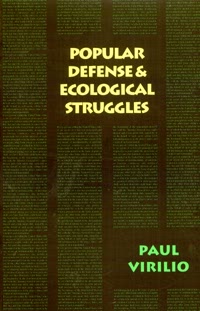
“Ecological catastrophes are ony terrifying for civilians. For the military, they are but a simulation of chaos, an opportunity to justify an art of warfare which is the more autonomous as the political State dies out. At this point, all civilian populations are helpless victims of the scam, of this ransacking of the world’s resources.” – Paul Virilio
What is popular defense? From whom do we have to defend ourselves? Originally civilian populations were capable of defending themselves both in times of peace and war. A military racket was subsequently imposed upon them in the name of protection and popular defense lost its capacity to resist external attack. In case of total war, between the native populations which form the constitutional basis of all great modern states and the military now in charge of defending them there was no more “common culture.” Industrial wars subsequently managed to replace the thousand-year-old pact of semi-colonization with total colonization. First experimented with in South America,...
Read more about: Popular Defense & Ecological Struggles »